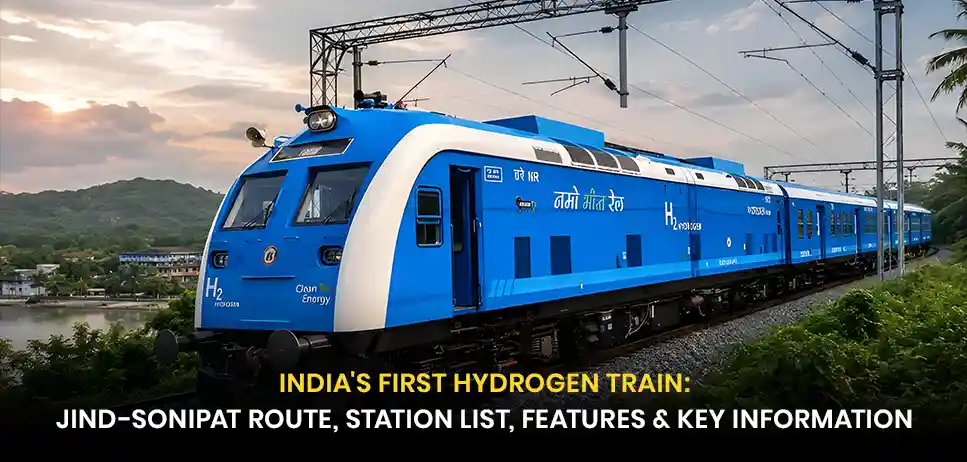
The first hydrogen-fuelled train in India has finally rolled out on the Jind-Sonipat route in the state of Haryana. The train was inaugurated by Prime Minister Narendra Modi on July 17.
The Jind-Sonipat hydrogen train distance will operate daily on the 89-km-long railway track under the Northern Railway network. This will be an important milestone for Indian Railways to experiment with the hydrogen-fuelled trains under practical conditions.
This is India’s first-ever hydrogen train in India that does not have any diesel. For this reason, it is also referred to as green rail technology. In this comprehensive article, we will discuss the working process of this train, its safety features, and its significance to the Indian Railways.
India's First Hydrogen Train is a passenger train that generates its own power through the use of hydrogen. It does not require any diesel or grid power from the overhead line. The hydrogen train generates electricity through a hydrogen fuel cell for driving the electric motors.
The train was designed and developed in India. The technical specifications of the train were prepared by RDSO. The hydrogen train would be manufactured in the Integral Coach Factory (ICF), Chennai.
It is an Atmanirbhar Bharat (self-reliant India) programme, as this train has been designed, developed, and manufactured in India.
It is a pilot project, which implies that Indian Railways will operate this train on one route initially and later use this technology on other routes. The pilot route for this train would be the Jind-Sonipat route in Haryana.
Check the table below for important information about India's First Hydrogen Train.
| Feature | Detail |
|---|---|
| Train Name | India's First Hydrogen Train |
| Train type | 10-coach Hydrogen Fuel Cell Trainset |
| Power system | 1,200 kW Hydrogen Fuel Cell Propulsion System |
| Maximum Approved Speed | 75 km/h |
| Design speed | 110 km/h |
| Passenger capacity | Around 2,600 passengers |
| Route | Jind Junction – Gohana Junction – Sonipat |
| Coach Composition | 2 Hydrogen Driving Power Cars (DPCs) + 8 Trailer Coaches (TCs) |
| Hydrogen Storage Capacity | Approximately 3,000 kg of hydrogen at Jind Depot |
| Manufactured By | Integral Coach Factory (ICF), Chennai |
| Designed By | Research, Design & Standards Organisation (RDSO) |
| Launch Date | 17 July 2026 |
The hydrogen train will run on a daily basis on the route connecting Jind to Sonipat, which is part of the Northern Railway. It takes two hours to travel, and there will be several stops in between to ensure people in smaller cities can take advantage of the service.
The train will have connections from Jind Junction to Gohana Junction to Sonipat. The intermediate stops will include smaller towns as well. The maintenance facility for the hydrogen train will be at Shakurbasti in Delhi, where Indian Railways has built it.
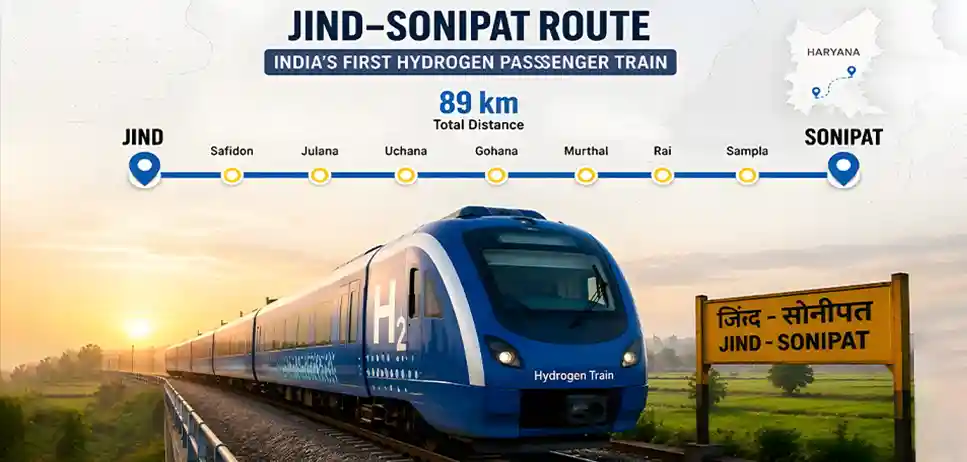
This particular route is used by those commuters who travel inside Haryana. Currently, many individuals use road transport facilities for this purpose.
The train operates on a Proton Exchange Membrane Fuel Cell (PEMFC). PEMFC produces electricity through a chemical process between hydrogen and oxygen. The reaction occurs via a unique type of membrane known as perfluorosulfonic acid (PFSA). Water vapour and heat are the only products of this reaction. The train does not emit any smoke, soot, or carbon dioxide from its engine.
The energy density in one kilogram of hydrogen is higher than that of diesel. In one kilogram of hydrogen, there is energy worth 120 megajoules (MJ/kg). On the other hand, in one kilogram of diesel, there is 43 MJ/kg of energy. Therefore, hydrogen will be a good fuel without causing pollution.
There are three main parts in each Hydrogen Driving Power Car (DPC) of the train. They include fuel cells, lithium iron phosphate (LFP) batteries, and hydrogen gas cylinders. Fuel cells produce electricity, LFP batteries help store extra electricity, and hydrogen cylinders carry hydrogen gas.
Also Read: Lucknow-Kanpur Expressway
In contrast to diesel trains that use fuel to generate motion, this train makes use of electricity produced by the combination of hydrogen and oxygen within the train. The only emission from this process is water vapour. This makes it a far better means of transportation.
Some of the important characteristics of the system are as follows:
The project has been developed in India with the help of Indian technologies and expertise from the Integral Coach Factory (ICF) and Research Designs and Standards Organisation (RDSO).
Indian Railways constructed its biggest facility for hydrogen storage and refuelling at Jind in the state of Haryana. It is capable of storing almost 3000 kilograms of hydrogen at once. The licensing by the Petroleum and Explosives Safety Organisation (PESO) is issued to allow hydrogen gas to be stored and dispensed from the site.
The facility complies with international safety standards, which include NFPA-2 safety regulations of the National Fire Protection Association in the USA and ISO 19880 standards of the International Organisation for Standardisation. The whole system was independently tested for safety by TÜV SÜD, a technical inspection company of Germany.
The Jind hydrogen train storage facility contains a hydrogen compression system for fuelling, a technical team and spare parts for maintenance, and a backup compressor. The backup compressor ensures that there is no interruption in fuelling if the primary compressor undergoes any maintenance.
Indian Railways has provided a host of safety systems in the train and hydrogen refuelling stations. These safety systems monitor for any faults right from the stage of storage to dispensing the hydrogen into the train.
Transport and real estate normally move together. As soon as there is any talk about the construction of roads, metros, or railways, a lot of people begin observing the surrounding properties.
Property seekers in Sonipat already perceive the town as a cheap place located near Delhi. Increased connectivity through railways will make the town all the more attractive.
Similarly, this would be the case with property in Jind if, in the future, there is any further development from this current project. Good transport facilities make the city more accessible and can help in building housing and commercial projects.
There is no instant spike in property rates expected, but improved connectivity is always a positive development. Jind Sonipat hydrogen train stations encourage buyers to invest in properties in this location.
India's first hydrogen-powered train is not limited to just one trainset alone but will be used to develop the systems and personnel capabilities required for hydrogen trains in the future. Through this project, Indian Railways will be able to test the technology, processes, and maintenance associated with hydrogen trains.
This train project will help India achieve its goals related to the National Green Hydrogen Mission and India's net-zero carbon mission. If this project succeeds, then Indian Railways may consider hydrogen trains on other routes in the future. This will lead to less use of diesel and less pollution from the trains, especially trains that do not have overhead lines.
Also Read: Ganga Expressway
India’s First Hydrogen Train is one such game-changing initiative which will make train journeys cleaner and sustainable. It will be operational on the Jind-Sonipat route in Haryana after being inaugurated by Prime Minister Narendra Modi on 17th July 2026.
The hydrogen fuel cells of the train will enable it to produce energy for itself by emitting nothing but water vapour. The train not only includes a hydrogen storage and refuelling station but also features the train itself and all kinds of safety mechanisms both onboard and within the plant itself.
India’s first hydrogen train will also serve as an important step towards India’s National Green Hydrogen Mission and achieving carbon neutrality. This will help the railways to decide whether to use hydrogen-powered trains on other routes as well.
Recent Posts
Follow Us




Leave a Comment