
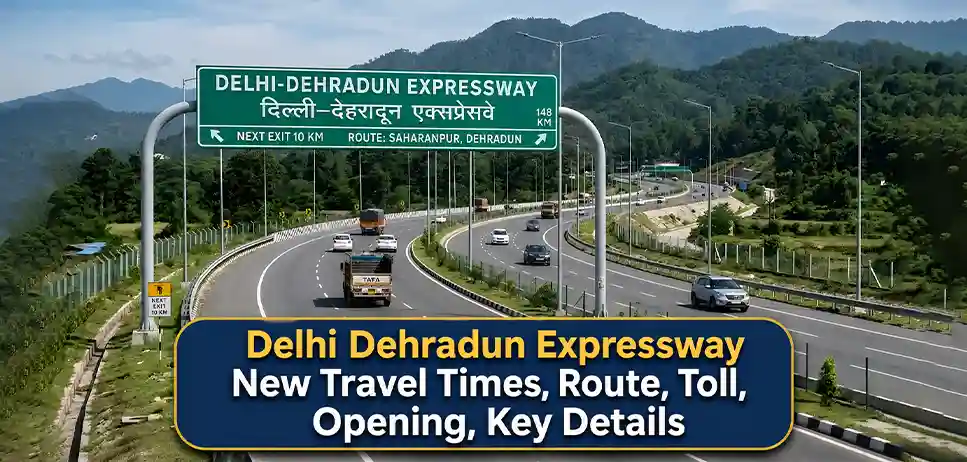
The Delhi-Dehradun Expressway is an important infrastructural development that provides connectivity between Delhi and Dehradun. The name of another name for this project is Delhi-Dehradun Economic Corridor, which is a 210-km-long, six-lane toll-free economic corridor connecting Delhi to Dehradun.
PM Narendra Modi officially inaugurated it on April 14, 2026, trimming down travel time between Delhi and Dehradun from 6 hours to just 2.5 hours. This expressway starts from Akshardham Temple (Delhi) and runs through Delhi, Baghpat, Baraut, Shamli, Saharanpur (Uttar Pradesh), to Dehradun (Uttarakhand). It integrates the NH-709B, NH-307, and NH-344G highways.
This is a six-lane (with an expansion plan for eight lanes) controlled-access highway that stretches for 210 kilometres and has been constructed at a cost of around ₹12,000 crore through four stages by NHAI, with construction starting in December 2021.
Apart from all of the above, this highway will have state-of-the-art road construction, broad lanes, flyovers, tunnels, bridges, and even greenways. The highway will be more connected with important cities and tourist spots like Haridwar, Rishikesh, and Mussoorie.
Two unique features of this project are its 12-kilometre stretch above Rajaji National Park, which is Asia’s largest wildlife corridor, and its 200-meter-long elephant underpasses.
The Delhi to Dehradun New Expressway has been opened to the public. Finally, after all the delays and changes in dates, the full length of the expressway is now ready for use, and there is no need to travel piecemeal anymore.
The Prime Minister of India, Narendra Modi, visited the city of Dehradun for its opening ceremony. He also paid a visit to the wildlife passage constructed at the elevated portion of the expressway. This is the portion that goes through the forest land with animal passages below and roads running above.
| Detail | Information |
|---|---|
| Total Length | 210 km (approximately 213 km including approach stretches) |
| Start Point | Akshardham Temple, East Delhi |
| End Point | Dehradun, Uttarakhand |
| States Covered | Delhi, Uttar Pradesh, Uttarakhand |
| Number of Lanes | 6 lanes (expandable to 8 lanes) |
| Design Speed | 100 km/h minimum |
| Project CostApproximately | Rs. 11,868 to Rs. 13,000 crore |
| Entry/Exit Points | 16 across the full corridor |
| Underpasses | 113+ (VUP, LVUP, SVUP types) |
| Railway Overbridges | 5 |
| Major Bridges | 4 |
| Bus Shelters | 62 |
| Service Roads | 76 km running parallel to the expressway |
| Elevated Road Sections | Approximately 29 km |
| Developed By | NHAI under Bharatmala Pariyojana (EPC model) |
| Foundation Stone | February 26, 2021 by Nitin Gadkari |
| Opening | April 14, 2026, by PM Narendra Modi |
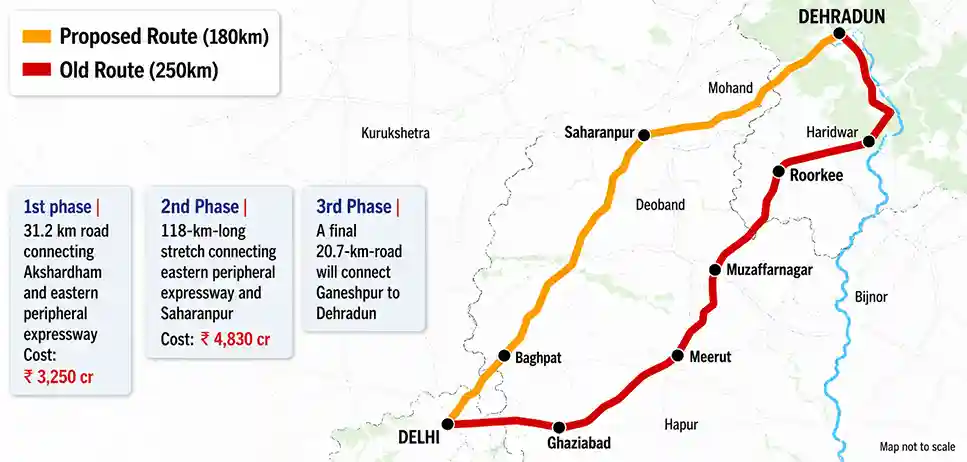
The expressway runs from Delhi to Dehradun via significant portions of Uttar Pradesh and Uttarakhand. It starts from the Akshardham Dehradun Expressway in Delhi and passes through Baghpat, Shamli, Saharanpur, and ends at Dehradun. Careful planning has been done for the construction of this expressway in order to ease traffic congestion.
The foremost benefit offered by the Expressway is that of reduced travel time. Until now, people took about 6 to 7 hours from Delhi to Dehradun, depending on traffic jams. After the completion of this expressway, it is expected that the distance will be covered within just 2.5 to 3 hours, making it easier for people to travel during weekends or go on business trips.
This expressway is being constructed with the help of many state-of-the-art facilities, including wide roads, flyovers, tunnels, corridors for animals, and safety systems. Additionally, green technologies have also been adopted for reducing their environmental impact.
Top developers in Gurgaon are moving beyond just developing apartments. Gurgaon looks and feels like a modern international city today, thanks mainly to innovative developers. They are creating complete mini-cities and lifestyles. Here’s how they are shaping modern urban living in easy points:
| Details | Phase I | Phase II | Phase III | Phase IV |
|---|---|---|---|---|
| Route | Akshardham, Delhi to EPE Interchange | EPE Interchange to Saharanpur Bypass | Saharanpur bypass to Ganeshpur | Ganeshpur to Dehradun |
| Length | 32 km | 118 km | 40 km | 19.5 km |
| Type | Brownfield | Greenfield | Brownfield | Brownfield |
| Number of Lanes | 12 (6 Express + 6 Local) | 6 | 6 | 4 or 6 |
| Status | Completed | Completed | Almost complete | Almost Complete |
The initial phase of the expressway route will cover an area from Delhi to EPE. This phase consists of building wide roads, elevated highways, and better traffic infrastructure. This phase focuses on relieving congestion in Delhi and nearby places by providing a faster mode of transport for daily travelers. In the first phase of the expressway, the route is 32 km in length, and the 6.4 km route from Geeta Colony to Khajoori Khas is elevated.
The second phase of the expressway route runs from EPE to Saharanpur. This phase involves building bridges, underpasses, highways, and service roads. This phase of the project is longer than the other phases, and this is a 118 km-long route. It is a six-lane expressway and includes 7 interchanges along the route.
The third phase runs through a route connecting Saharanpur to Ganeshpur on NH307, and it is a 40 km route. This route leads to the southern entrance of Rajaji National Park.
The current residential complexes are embracing an environmentally conscious approach, in which wildlife corridors can be an integral part of the design. The wildlife halls will be designed to promote the conservation of natural habitats for birds and other wildlife, enabling the movement of wildlife through green zones within the residential complex.
The current project entails green gardens, green lawns, and green zones where plants and trees will be planted. The gardens and lawns will contribute to the reduction of pollution and provide fresh air. Apart from that, the adoption of green zones ensures the conservation of wildlife, particularly birds and other animals.
Rainwater harvesting systems have been integrated into this project, which ensures the recharge of the water table in the process of providing fresh water and eliminating wasteful practices.
The current project has adopted energy-saving lighting systems as well as eco-friendly materials in construction. Apart from that, the project also embraces effective waste management strategies.
Also Read: Top Branded Residences in Gurgaon
Delhi Dehradun Expressway is one of the most significant highway projects in North India. The new-age expressway is constructed to make travel from Delhi to Dehradun faster and more comfortable.
In addition to good connectivity, people like to get information about the toll rate on the Delhi Dehradun Highway before traveling. The toll facility on the expressway will be modern, fast, and efficient to serve daily commuters and travelers.
| Tolling Model | Closed tolling system where users pay only for the exact distance traveled on the expressway |
| Technology Used | Next-Generation FASTag 3.0 integrated with satellite-based GPS tracking |
| Toll Booths | No fixed toll booths; toll amount is deducted automatically through the linked FASTag account |
| Recommended FASTag Balance | Minimum balance of Rs. 3,000 recommended for travelers using the full Delhi to Dehradun route |
| Toll Collection Start | Toll collection started after the official inauguration on April 14, 2026 |
| Advantage | Seamless travel without stopping at toll plazas, ensuring faster movement and less traffic congestion |
The project is one of the major infrastructural projects in North India. The expressway project aims at enhancing connectivity and providing better transport links between Delhi and other states like Uttar Pradesh and Uttarakhand. Apart from enhancing the quality of travel, it is also expected to provide numerous benefits to the economy and real estate industry.
The most significant impact of the Expressway Delhi Dehradun will be on travel convenience and ease. Until now, long distances and heavy congestion have made it difficult for people to travel between Delhi and Dehradun. Once this expressway becomes operational, people can expect a reduction in the journey time.
People going for daily commute, tourism, and business travellers will greatly benefit from improved transport links through expressways. Better transport facilities will be beneficial for the development of the economy and the employment of people in this region.
The development of the expressway is done according to stylish planning standards with consideration of environmental protection measures. There will be the construction of green belts, the plantation of trees, and wildlife crossings to minimize the effects of the development on the environment. Such measures contribute towards the protection of forests and wildlife habitats that are found within proximity to the expressway development.
Improved traffic movement can help save fuel use by vehicles and hence minimize environmental pollution caused by congestion on roads. This helps promote sustainable development of infrastructure facilities and a balance between urbanisation and environmental protection.
The development of the Delhi Dehradun Expressway has led to a boost in growth in the real estate sector. Properties around the expressway have recorded high demand for residential plots, apartments, commercial space, and townships. The improved accessibility of the property sites makes them more appealing to potential buyers and investors.
Value appreciation of properties in the vicinity is expected due to improved infrastructure and investment prospects. Property developers have come up with new development projects.
Following is the Delhi Dehradun Expressway village list Route.
The expressway construction and land development work are currently progressing across several villages in different districts of Uttar Pradesh.
| District | Village |
|---|---|
| Baghpat |
|
| Muzaffarnagar |
|
| Shmali |
|
| Saharanpur |
|
Apart from improving connectivity between various towns, this expressway is going to facilitate the process of development in the villages that come under this route of the expressway. Some of the advantages expected from this expressway are:
With improved infrastructure, the coming years can witness the quick development of the villages that come under the route of this expressway.
Recent Posts
Follow Us




Leave a Comment