

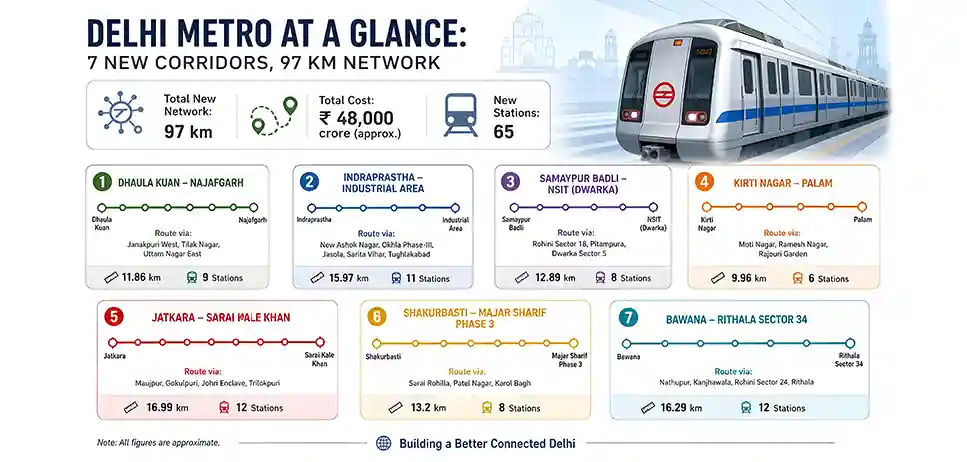
The Delhi government recently approved the development of another large-scale project, namely Phase V(B) of the Delhi Metro. In the near future, the government plans to develop 97 km of new rail lines and 65 new stations.
This project involves a comprehensive approach to bringing out all the neglected areas into the mainstream. It will become possible to get to any part of Delhi using the metro services easily and quickly. And it costs next to nothing!
In case you happen to live in any of the areas like Najafgarh, Narela, Rohini Sector 34, or even in the crowded locality of Mayur Vihar Phase III, then there certainly is some great news waiting for you.
The chief minister of Delhi, Rekha Gupta, has announced the launch of an extension plan of the Delhi Metro. This would involve 97 kilometres of metro rails, 65 new stations, and 7 new routes altogether under the project called Delhi Metro Phase V(B).
This corporation has estimated the budget of the project at around Rs 48,204 crore. The whole project has been divided into seven corridors, but what’s really interesting is that there will be four priority corridors. Authorities have set the deadline for completion of these priority corridors at 2029.
| Proposed Route | Length | No. of Stations |
|---|---|---|
| Samaypur Badli to Narela | 12.9 km | 8 |
| Dhansa Bus Stand to Nangloi | 11.8 km | 9 |
| Central Secretariat to Kishangarh | 16 km | 10 |
| Jor Bagh to Mithapur | 17 km | 12 |
| Shastri Park to Mayur Vihar III | 13.2 km | 8 |
In addition, the proposed metro network will feature an elevated track route of 16 kilometres long from Keshavpuram to Rohini and another underground track route of 10 kilometres from Kirti Nagar to Palam.
Also Read: Google Leases Office Space in Gurgaon
Each corridor addresses a distinct problem area. Corridor 1 brings the metro connection to Najafgarh at last. Corridor 3 extends the reach of the network up to Narela, which is one of the least developed areas in north Delhi.
Corridor 7 will connect lakhs of people living in the Rohini and Pitampura regions who now travel through congested roads.
The stretch of Jor Bagh to Mithapur in Corridor 5 is undoubtedly the most interconnected one, with five metro lines being connected through this stretch alone.
Corridor 6 would change the lives of East Delhi residents in Geeta Colony, Gandhi Nagar Market and Mayur Vihar Phase III by linking them with the Red & Blue lines.
As soon as DMRC announces any route for their metro project, the real estate business is buzzing. It is known as the metro effect phenomenon. It was witnessed in Gurgaon and Noida, and this time, North Delhi will experience this boom.
With the deadline in mind, 2029, builders are eagerly trying to purchase properties around the stations of future routes. In fact, it is an opportunity to invest in suburban areas that were far off earlier. For example, already a lot of interest is being shown in the property in Narela.
Buyers have realised the importance of living in that area when the metro station comes up. One should expect at least a 20-25% increase in property rates before the completion of the metro project.
Recent Posts
Follow Us




Leave a Comment