
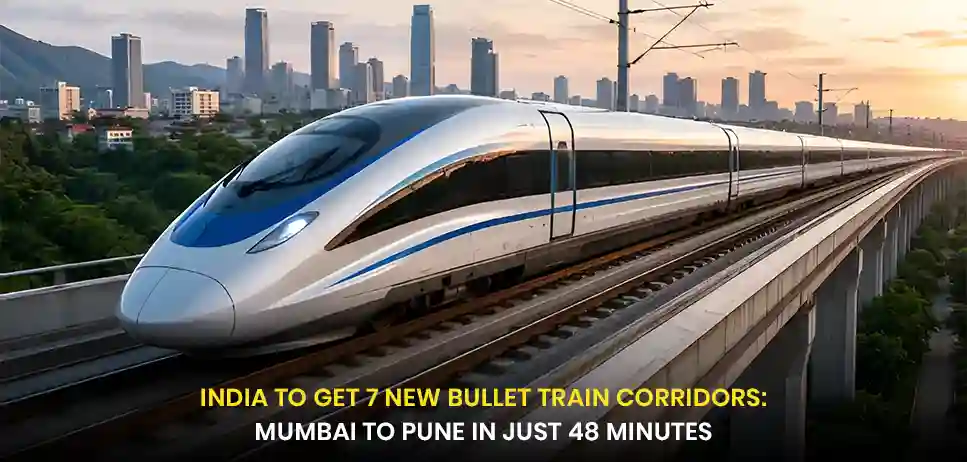
There is going to be a revolutionary change in commutes in India. The bullet train concept in India is certainly no longer limited to brochures and research papers only. The pillars have been erected, viaducts have been commenced, and selected tracks laid in Gujarat on the Mumbai-Ahmedabad corridor of the bullet train.
The bullet train concept in India is not only about the speed of the train for commuters and investors. It is about the distance people can cover from the metro station to reach the office.
India is all set to witness a revolutionary travel transformation soon. The central government of India has approved seven bullet train corridors in India. This is going to connect some of the biggest cities in India using this fast rail network.
Railway Minister Ashwini Vaishnaw has mentioned these new bullet train routes, and he mentioned that Prime Minister Narendra Modi has approved these corridors. New bullet train routes have been launched in the Union Budget 2026-27 with an unprecedented allocation for railways.
What is the number of bullet trains in India that are proposed? Seven bullet trains in India are planned according to the National Rail Plan. Out of the seven, one bullet train project is being constructed, while three are approved and have their DPPs. Three other projects are under survey, and they make up the first bullet train map in India.
The NHSRCL has taken measures to assess the capability of the companies that will design and construct the next generation of Indian bullet trains called B35. They will be designed and constructed in India and will form the new generation of bullet trains in India.
The design of the B35 trainset has been done in such a way that it operates at a speed of 350 km/h and runs. It has an operational speed of 320 km/h and thus becomes the fastest train in India, as reported by The Indian Express.
| Route of the Bullet Train | Distance | Bullet Train Time |
|---|---|---|
| Mumbai to Ahmedabad | 508 Km | 1 hour 57 mins |
| Mumbai to Pune | 150 Km | 48 mins |
| Bengaluru to Chennai | 350 Km | 73 mins |
| Bengaluru to Hyderabad | 618 Km | 2 hours 10 mins |
| Pune to Hyderabad | 560 Km | 2 hours 8 mins |
| Delhi to Lucknow | 490 Km | 2 hours |
| Delhi to Varanasi | 813 Km | 3 hours 15 mins |
| Varanasi to Siliguri | 800 Km | ~6 hours |
The total length of these corridors is 4,000 kilometres, and investments of about Rs 16 lakh crore are expected to come from them, as per government sources.
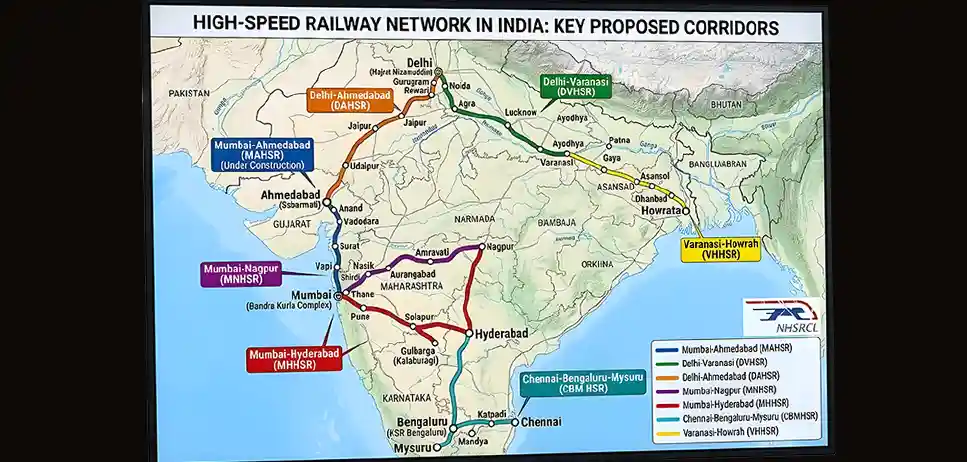
Metros and the rapid development of Tier-2 cities can be understood with respect to the bullet train that exists on the map of India. The Western Corridor joins Mumbai and Ahmedabad and extends on to join the city of Delhi in the future.
The Northern Corridor has been planned to join Delhi and Varanasi by crossing the industrial belt of UP. Further, in the Southern Corridor, the time taken to travel from Chennai to Mysuru, bypassing Bangalore, would reduce from 7 to 2 hours.
The following map depicts the seven upcoming bullet train routes in India. The seven different colours represent the seven different routes.
Bullet train construction is a very expensive process because it includes special tracks, bridges, tunnels, and stations. The budget for just the Mumbai to Ahmedabad railway has been more than Rs 85,000 crore till now. The total cost of construction has reached nearly Rs 198,000 crore due to extra costs incurred in delays of land acquisitions, etc.
Total investments by way of the construction of these seven corridors would be approximately Rs 16 lakh crore. A record investment allocation of Rs 2,78,000 crore has been made for Indian Railways in the Union Budget 2026-27, making it the highest ever so far.
There are three bullet train corridors among the 7 new corridors in the South Indian region. This is important because the majority of the cities in the south of India, like Bengaluru, Chennai, and Hyderabad, are major technology and commerce centres in the region.
Currently, travel from one city to another by train takes between 5 and 8 hours. The travel time on the bullet train from the same cities will take a mere 73 minutes to 2 hours only after its development.
The Bengaluru-Chennai corridor will be quite significant since it will be the first high-speed rail corridor in Southern India and will link two major information technology hubs in the country.
Also Read: Delhi To Get 97 km Of New Metro Lines
India is one of the largest countries with more than 1.4 billion people. Millions of people travel from one city to another each day for different purposes such as employment, education, and other personal tasks.
As the population grows and the cities develop, the burden of roadways, airports, and normal trains increases. There are several benefits of bullet trains. Bullet trains are faster than cars and normal trains. They are greener when compared to flights. Bullet trains cut down the traffic on highways.
The construction and operation of bullet trains can create job opportunities. And finally, they can also help in developing smaller cities and towns around the route.If people can travel between two cities within an hour, then their lives and working patterns will be affected significantly.
For instance, a person could reside in Pune and work in Mumbai and not waste time on the commute. Similarly, a businessman in Chennai could travel to Bengaluru and back the same day.
The real estate value of Gurgaon and Noida increased twofold once the Delhi Metro came to them. This is what a bullet train can do in less time.
Plots within 2-3 km of the confirmed station have already risen 25-40% from 2021 onwards. Surat, Vapi, and Anand have seen new township advertisements saying, “25 minutes to BKC by bullet train.”
These areas were previously known as the main industrial centres of the cities. With the confirmed station, builders are pitching them as budget homes for Mumbai and Ahmedabad professionals. There could be a surge in demand for flats at Vapi and properties at Bharuch when dates get firmed up.
Logistics and office spaces are preferred in areas where movement of staff is easy. In the vicinity of the stations of Surat and Vadodara, more enquiries are being received. Rental demands increase automatically.
In the Delhi-Ahmedabad and Delhi-Varanasi routes, Jaipur, Udaipur, Agra, and Kanpur will become “super-commutable” cities for Delhi. Early investors are making land purchases in the station zones of Jaipur and the Lucknow-Kanpur area.
The development of the bullet train project in India is just one element of a much broader effort for the modernization of its railway network. In addition to the development of the high-speed train project, India is also developing its Vande Bharat semi-high-speed train network.
If the seven bullet trains become successful in India, then India would be among the small list of nations that have an extensive bullet train network, such as Japan, China, France, Germany, and Spain.
Recent Posts
Follow Us




Leave a Comment