
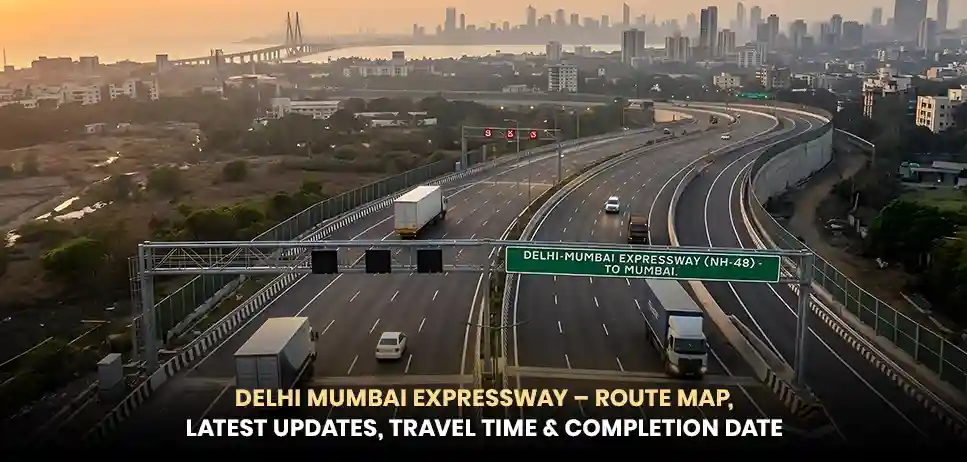
For anyone who has experienced the traditional NH-48, getting from Delhi to Mumbai is a challenging experience that can take up to 24 to 30 hours in freight transport. However, the Delhi Mumbai Expressway makes all the difference.
Covering a distance of 1,350 kilometres across six states, this ultra-modern 8-lane highway brings the travel time down to only 12 hours. Apart from reducing travel time, this expressway is responsible for boosting the economy in a big way through logistics, retail, and even suburban real estate development.
The Delhi-Mumbai Expressway sets a new benchmark for intercity travel in India. This is how it works.
The Expressway is designed to avoid busy city roads and traffic jams, making travel between Delhi and Mumbai faster, smoother, and more convenient.
| Order | Section / State | Key Terminals / Regional Coverage | Distance (approx.) | Cumulative Distance |
|---|---|---|---|---|
| Start | Northern Terminal | Delhi (DND Flyway) / Gurugram (Sohna) | 0 km | 0 km |
| 1 | Haryana | Sohna, Faridabad, Nuh, Ferozepur, Jhirka | 129 km | 129 km |
| 2 | Rajasthan | Alwar, Dausa, Lalsot, Sawai Madhopur, Kota | 373 km | 502 km |
| 3 | Madhya Pradesh | Bhanpura, Garoth, Jaora, Ratlam, Thandla | 244 km | 746 km |
| 4 | Gujarat | Dahod, Godhra, Vadodara, Bharuch, Surat, Valsad | 426 km | 1,172 km |
| 5 | Maharashtra | Virar, Palghar, Vasai, Amane | 171 km | 1,343 km |
| End | Southern Terminal | Mumbai (JNPT Port / Virar Terminal) | - | 1,350 km |
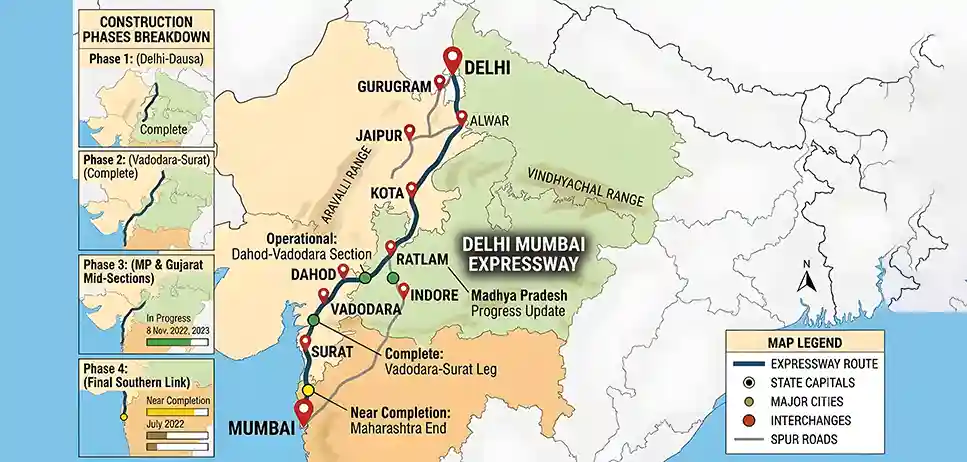
| State / Union Territory | Distance Covered | Major Cities & Interchanges Connected |
|---|---|---|
| Delhi | 12 km | DND Flyway, Maharani Bagh, Kalindi Kunj |
| Haryana | 129 km | Sohna, Faridabad, Nuh, Ferozepur, Jhirka |
| Rajasthan | 373 km | Alwar, Dausa, Lalsot, Sawai Madhopur, Kota |
| Madhya Pradesh | 244 km | Bhanpura, Garoth, Jaora, Ratlam, Thandla |
| Gujarat | 426 km | Dahod, Godhra, Vadodara, Bharuch, Surat, Valsad |
| Maharashtra | 171 km | Virar, Palghar, Vasai, JNPT (Navi Mumbai) |
More is involved than merely reducing travel time between two major capitals; it functions as a backbone connecting the satellite cities, ports, and industrial areas to one another:
Building an extensive highway network through different terrains requires some meticulous planning. In order to avoid any delays, the NHAI has divided the entire trade corridor into four major regions and issued 52 contract packages for the task.
| Section Name | Length | Packages | Main Role |
|---|---|---|---|
| Section 1: DND-Faridabad-KMP | 59 km | 3 | Takes traffic out of central Delhi down into Haryana. |
| Section 2: Sohna-KMP-Vadodara | 844 km | 31 | The long highway stretch through Haryana, Rajasthan, MP, and Gujarat. |
| Section 3: Vadodara-Virar | 354 km | 13 | Links South Gujarat's manufacturing hubs with northern Mumbai outskirts. |
| Section 4: Virar-JNPT | 92 km | 5 | The final coastal leg ends at the JNPT port in Navi Mumbai. |
It has to be admitted that travelling from Delhi to Mumbai via expressway in 2026 is still not a single unbroken drive.
But much has already been completed, and driving along the northern part shows it quite well. By March 2026, according to the government estimates, almost 929 km of the entire corridor and spurs were open to the public.
Until the Delhi entry, which has been missing for some time, got completed in August 2026. When the 9 km section from DND Flyway to Jaitpur became open for testing. No more need for detours for people living in South Delhi, Noida or Ghaziabad to enter the expressway!
What is currently open, approximately:
So what's still missing?
The 30 km gap from Limkheda to the MP border is known as Package 26. Rumour has it that it will be completed either by December 2026 or January 2027. Once it's done, then there will finally be a way to travel from Delhi to Kharel in Navsari via the expressway.
There will be a link from Delhi to Vadodara by December 2026. The problem with the Mumbai side is it's taking too long. There are three packages in Maharashtra that haven't been completed yet. It's been moved to March 2028 at best.
It means that 2026 is not going to be the "done" date. It's going to be the first time the north-central corridor behaves like a single road.
| Stretch | Ground reality in late 2026 |
| Delhi - Vadodara | Almost there, last gaps closing |
| Vadodara - Mumbai | Open in bits, the full link is still 2027-28 |
| Full corridor | Work going on in patches |
The building in difficult areas with heavy monsoons and land acquisition along the Maharashtra coast delayed initial dates slightly. The complete completion of the entire 1,350 km Delhi Mumbai Expressway is scheduled to occur in the years 2027-2028.
| Timeline | Phase / Milestone | Key Developments & Status |
|---|---|---|
| 2018-2019 | Project Approval & Land Acquisition | The project is officially greenlit; land acquisition begins across 6 states. |
| 2023 | Initial Section Openings | Sohna-Dausa (246 km) and the Madhya Pradesh (244 km) sections opened to traffic. |
| 2024-2025 | Key Feeder & Industrial Expansion | The Vadodara-Bharuch stretch and the Bandikui-Jaipur spur are fully operational. |
| 2026 | NCR Entry & Rajasthan Extensions | DND-Faridabad entry link and Kota-Bundi bypass sections commissioned |
| 2027-2028 | Final Completion Target | Final Gujarat-Maharashtra coastal stretches finish; full 1,350 km corridor operational |
Despite the fact that the expressway still needs to be connected to the coast, you can currently use the already completed sections for travelling across northern and central India.
A mega-project calls for a mega-budget. The total budget for the Delhi-Mumbai Expressway project amounts to around Rs 110,000 crore (Rs 1.1 lakh crore).
The toll for the Delhi Mumbai Expressway will depend completely on the distance covered. There won't be any fixed toll collected at a gate, but smart gantries will read the FASTag at entry and exit points and will bill accordingly based on the actual distance covered.
| Vehicle Category | Approx. Rate per km | Sample Toll (Sohna to Dausa - 246 km)s |
|---|---|---|
| Cars / SUVs / Jeeps | Rs 1.10 - Rs 1.50 | Rs 395 - Rs 420 |
| Light Commercial Vehicles | Rs 1.75 - Rs 2.40 | Rs 500 - Rs 550 |
| Buses / 2-Axle Trucks | Rs 3.75 - Rs 5.10 | Rs 1,150 - Rs 1,250 |
| Heavy Cargo Trucks (3-6 Axles) | Rs 5.50 - Rs 8.00 | Rs 1,800 - Rs 2,100 |
| 2027-2028 | Final Completion Target | Final Gujarat-Maharashtra coastal stretches finish; full 1,350 km corridor operational |
Note: To ensure smooth traffic movement and prevent accidents, slow-moving two-wheelers, three-wheelers, tractor trolleys and cycles are prohibited from entering the expressway.
Highways Bring Equity: The better connected the highways, the more value the lands get in proximity. All major nodes on this route have experienced tremendous growth in terms of value.
Evasion of Core City Values: People who cannot afford expensive apartments in core cities like Delhi are opting to buy in Sohna and Faridabad due to faster highway access.
Logistics and Industrial Belts: The medium-sized nodes like Dausa, Kota and Ratlam are witnessing huge demand for land and logistics-related infrastructure.
MMR Periphery Development: Those people dealing in real estate business in Mumbai are shifting their focus to nodes like Virar and Palghar with the opening of the final sections of the highway.
Master Planned Community Requirement: People interested in buying property in Navi Mumbai and Delhi are opting for modern township setups with fast road access.
Also Read: Best Time to Buy Property During Diwali
The Delhi-Mumbai Expressway is a fine example that showcases the future plans for Indian infrastructure development. The construction is not merely about time-saving on a lengthy journey.
The expressway connects rural zones with important commercial areas, helps remove trucks from congested city roads, and improves the value of the properties around its stretch.
When the entire route gets completed, travelling from Delhi to Mumbai by road will not only be convenient but will also become one of the best roads of the country.
Recent Posts
Follow Us




Leave a Comment